Blog

  • Using Zotero as a Robust Research Manager

    Using Zotero as a Robust Research Manager

    Recently a friend of mine posted about losing his entire research library in OneNote, which brought flashbacks to losing my entire research library many years ago in the Endnote 7 to X upgrade.
    You never want to see this.

    As such I am using this as an opportunity to briefly review my own research and backup practices, and run through how I use Zotero as a cloud synced, constantly backed up, and ultimately human readable research manager.

    Zotero

    Firstly, I have posted about Zotero a few times now, so there are more details in those posts. All available here: http://www.porterblepeople.com/tag/zotero/

    Zotero functions as the heart of the system and is used to make access to your research library quick and easy. But it is not the only part of the system and requires other aspects to function effectively. As I go into in one of my other posts the Zotero cloud storage capacity leaves a bit to be desired, so I store all of my PDFs in Dropbox. Zotero makes it easy to rename all the files easily and keep soft-links to the database.

    Zotero also allows you to keep notes with your documents, and those notes are indexable.

    Notes attached to a journal article.

    Those notes are also synchronised across devices using the Zotero cloud, and as raw text they take up very little space, so no worries there.

    Zotero Export (BibTeX)

    However, on its own Zotero isn’t great for being human readable. The last thing you want is for a service to decide that they are wrapping up and then you lose access to all your notes taken in that platform. I have had this happen with old OneNote, and seen it happen plenty of times with other platforms.

    Mercifully in the research manager world there is an open-source standard called BibTeX. Now BibTeX is usually used to generate references for LaTeX. If you are a LaTeX user then this is great (and this post is unlikely to be news to you) but for anyone else who doesn’t use LaTeX then this aspect is likely to be somewhat moot. Rather we are interested in the fact that it generates a plain-text human-readable export of your database. In the event of your software being withdrawn or rendered inoperable by something (e.g. 64bit upgrades) then you will always have all of your research entries and notes in plain text.
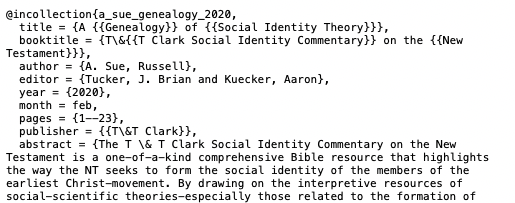
    BibTeX output from Zotero

    I will be the first to admit that it isn’t particularly pretty, but it is human readable and that is what matters. Plus it is entirely likely that someone out there will have written a converter to other platforms or software that uses BibTeX as an intermediary step, and therefore you can restore your data somewhere else. Absolute worst outcome is that you can still read your data without having to deal with a closed software format (and you could always learn LaTeX and keep using it).

    To do this Zotero needs a little plugin called BetterBibTeX, which I cover in this post: http://www.porterblepeople.com/2015/06/zotero-addons-extensions/ In that plugin you can export your library (File>Export Library…) and just check the “Keep Updated” box on export. I store my library in my Dropbox folder so that it is always cloud synced.

    Dropbox

    I use Dropbox as my cloud storage of choice, but most cloud storage will work well enough. I quite like Dropbox though as it also offers snapshots and the ability to roll back and restore files. Anything you use for cloud storage should offer those, in case you accidentally delete an entire directory. But if the cloud storage you choose offers the ability to roll back or undelete files, then use that.

    Fin

    That is it. Expecting more? It is a rather simple and robust backup system for a research library. I have had a hard drive die on my laptop before and it was annoying (downtime) but all of the data was restorable quickly and easily (being on 3G made it a bit slower). I was back up and running again in about 8 hours.

    tl;dr? Critical things: keep your files backed up, and your research database exported in a human readable format.

    Appendix A

    As some friends have pointed out using a cloud service as a backup is only one layer of redundancy, and may not save you. Especially if you have sync conflicts or longer offline periods. However, in this I am aiming for a balance of automation and simplicity, as complexity often introduces barriers to adoption of new practices.

    Personally I have Dropbox setup for constant sync which keeps my 3 machines synced, plus Time Machine backing up to a local server, and that doing a nightly rsync to my US server, and I also take a portable HDD into work that is on monthly rotation. Paranoid? No, I worked for a couple of unis in support roles and have seen first hand the devastating effects of losing research too many times. But it is a lot more to setup than a cloud service.

  • Citations with Scrivener 3 and Zotero – RTF Scan

    Citations with Scrivener 3 and Zotero – RTF Scan

    One of the tech questions I often get asked is how to setup citations in Scrivener using Zotero as a research manager. I have been meaning to write this post for quite a while, and was prompted on the topic again today.

    There are multiple ways that this can work, and in another post I may go into my extended setup utilising LaTeX and Biblatex-SBL. But for now here is a quick way that i use for shorter papers and collaborative work that requires Word.

    The core of this method is using the RTF Scan feature in Zotero, along with a short code that you input into Scrivener. The short codes come in various forms, but the simplest is just Author, Date and page reference as follows: {AuthorSurname, Year, pageref} with the braces surrounding the comma delimited code. This is simply inserted into a footnote within Scrivener like so:

    Of course this can cause issues if there are multiple references published by the same author in the same year. However, this can be mitigated in a few ways. The simplest is to use {AuthorSurname, “Title,” Year, pageref}. But occasionally this doesn’t work due to punctuation in the title. In these circumstances I like to add a short title to the Author field like so:

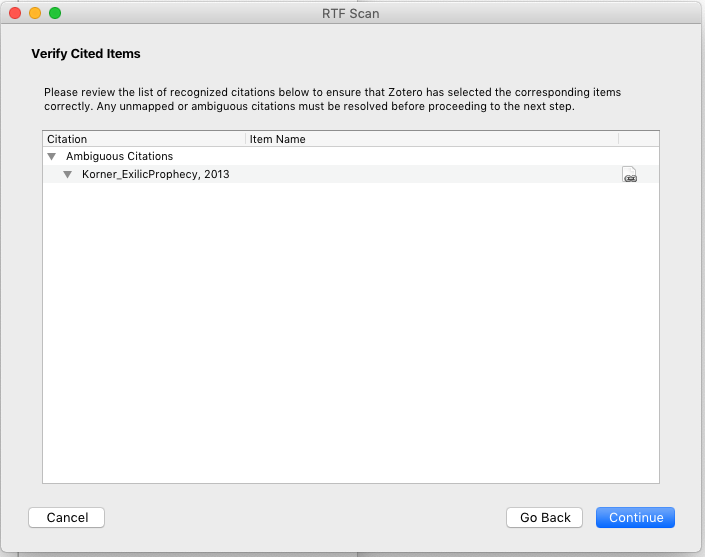
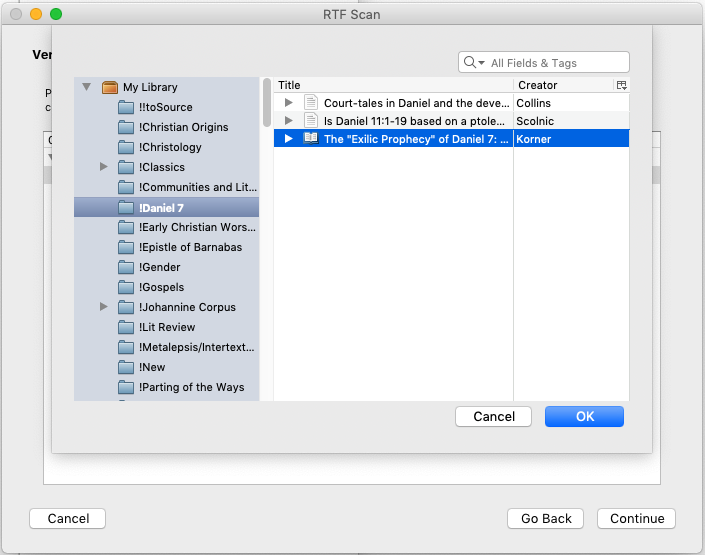
    This will then break the scan feature, but it will prompt you to select the correct paper. The short title then allows you to easily find that paper in your database.

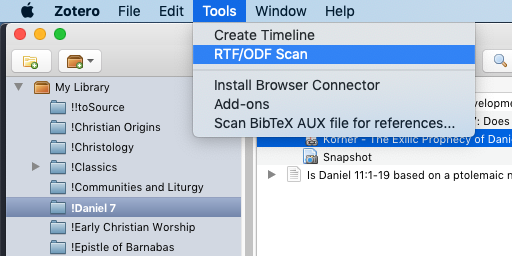
    You can then export your document to RTF like so:

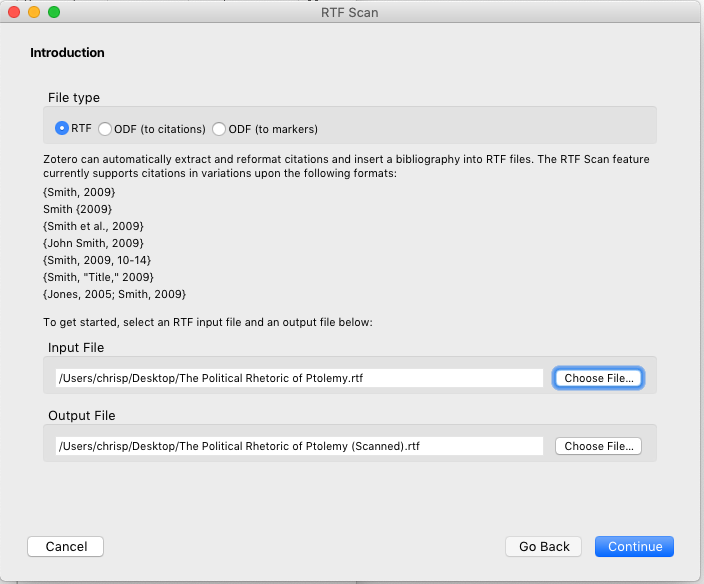
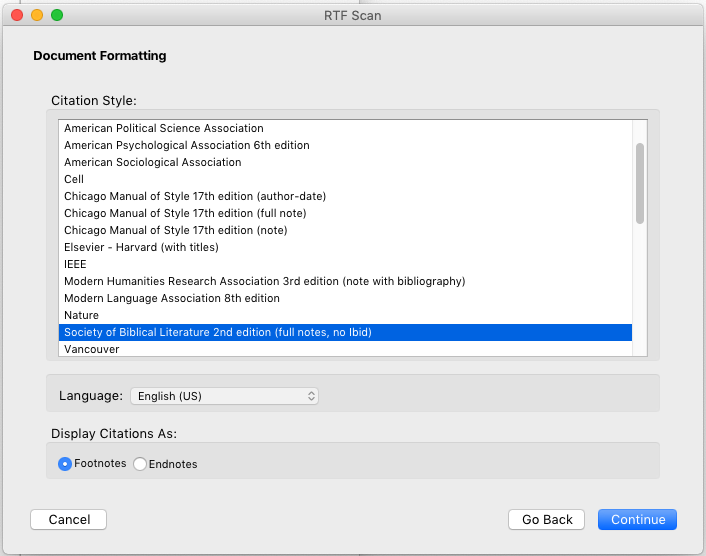
    This can then be scanned using the RTF Scan feature:

    If you have any scan codes that it cannot find it will prompt you to select them:

    Select your output format:

    Then an RTF document is generated that can be imported into Word for further manipulation, with the citation appearing like so:

    Overall it is a relatively simple process, and one that allows for rapid export of papers for various purposes.

    If you want to see how I use Zotero as a research manager, then I have posted on that here and on advanced Zotero here and then on Zotero++ here.

  • Stereotyping: A Preacher, The Gospel, and That Wedding.

    Stereotyping: A Preacher, The Gospel, and That Wedding.

    Disclaimer: I didn’t actually watch the wedding, and this post isn’t on the wedding per-se. But I have seen the plethora of responses to the sermon from the wedding, and this post is in relation to those. It is also psych heavy—although much is Cog.Psych 101—so if you were here for commentary on the sermon, or on wedding dresses, you have come to the wrong place.

    In the last few days I think everyone has been bombarded on social media by content about ‘that wedding’ [the Royal wedding if you have been living under a PhD driven rock like me]. However, also interesting has been the responses to the sermon from various segments of my social media feed (if you haven’t been seeing the same responses, well that is unsurprising given the opaque Facebook algorithms). In this post I want to briefly explore two of the main responses to the sermon that I have seen, and from the perspective of Social Identity Theory as I think it highlights something interesting about our interactions.

    Before we dive in though, for the sake of the conversation, I am standing on the shoulders of Penny Oakes (along with Alex Haslam and John Turner) on Stereotyping Theory[ref]Oakes, Penelope J., S. Alexander Haslam, and John C. Turner. Stereotyping and Social Reality. Malden: Blackwell Publishing, 1994.[/ref], as she has built on the work of Tajfel and Turner in the formulation of Social Identity Theory[ref]Tajfel, Henri, and JC Turner. “An Integrative Theory of Intergroup Conflict.” Pages 33–47 in Psychology of Intergroup Relations. Edited by WG Austin and S Worchel. Brooks/Cole, 1979.[/ref]. From that basis when I talk about ‘stereotyping’ I am meaning that cognitive process that we all utilise to ascribe ‘characteristics to people on the basis of their group memberships.’ [ref]Oakes et al., 1994, 1[/ref] Now I need to emphasise that this is not intrinsically a negative process, as our modern language uses it. Rather it is just a means of reducing cognitive load by perceiving people as members of social categories in the initial phase. Similarly, I will use the term prototype, which is merely the (often fictive) composite idea of the embodiment of the main characteristics of a social group. These basic definitions will be how i will use stereotype and prototype throughout this post.

    Onward therefore to the responses.

    The General Response

    The first response, to the sermon, I have seen from various friends is one of amazement and shock that such a good sermon could be preached and especially broadcast all over the world. After a bit of digging through various comment sections, I think much of this is to do with a mismatch between Bishop Curry and his sermon, and the cognitive stereotype of Bishops and wedding sermons.

    Firstly, a bit on stereotyping and dissonance. We use stereotypes as a means of cognitive minimisation, an effort to know more about an individual or group by ascribing the stereotypical characteristics of that group to the individual. This is done all the time, and we aren’t even conscious of it. In fact, just the other day an elderly lady approached me and started talking to me in an Asian language. This is a stereotypical ascription as she has ascribed the category ‘Asian’ to me on the basis of my racial presentation, and for her that category included language. Unfortunately for her my language repertoire outside of English is solely European, or dead languages, and the blank look on my face must have highlighted that. The response for her was one of sheer dissonance, effectively ‘how do you not know Asian language X, you don’t fit my category of Asian.’ It is this dissonance that draws our attention to things. Such as when Australians are shocked that a footballer graduates with a law degree, as most Australian footballers (of any code) have no tertiary education [real conversation].

    In the case of the wedding sermon it is a dissonance between the stereotype of Bishops and sermons, and what Bishop Curry actually delivered.

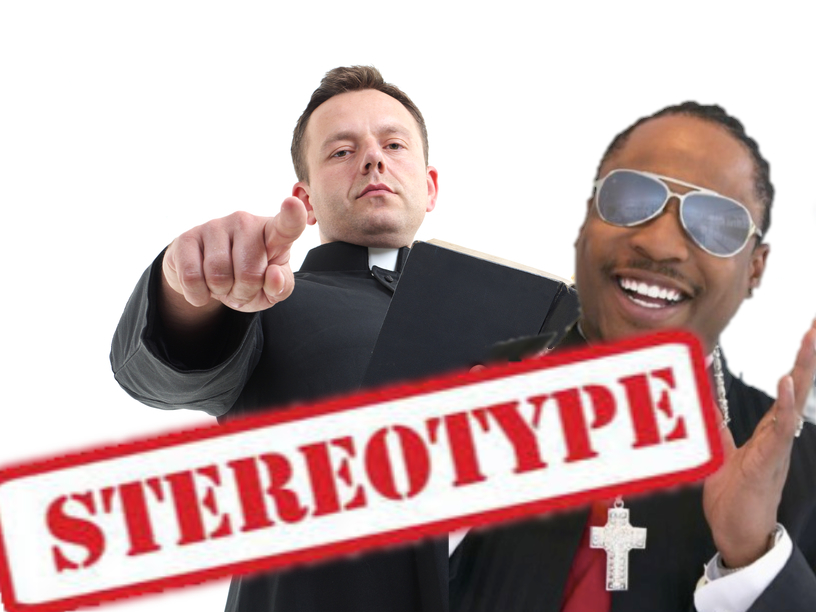
    Simply put, what people were expecting was:

    via GIPHY

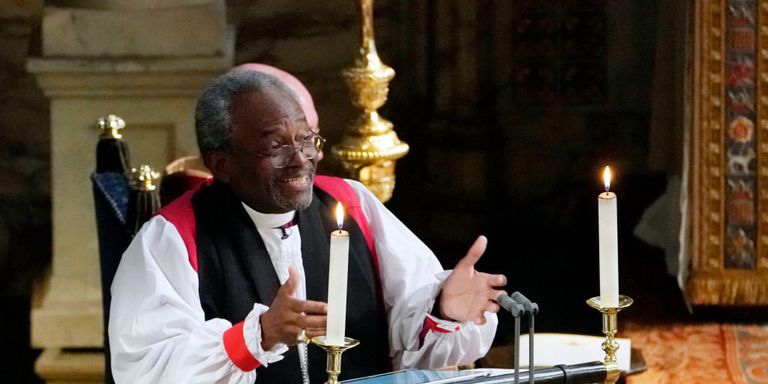
    But what they got was this:

    Needless to say this causes significant dissonance, much of which was writ large on the faces of several members of the royal family during the wedding. But it is also the same dissonance which has caused such significant engagement with the sermon and Curry. Because this dissonance forces a refactoring of the stereotypes at hand and reassessing where Curry fits. Much of this refactoring comes in the form of comparison with other social-category prototypes that might suit as a representative of a new stereotype for the individual. With this in mind it is completely unsurprising that there have been comparisons drawn with Martin Luther King, who stands as a comparative prototype for the social category that roughly exists as ‘African American preacher.’

    Now this is highly simplistic and significantly under-nuanced. But it serves as a basis of the other type of response I want to look at.


    The Conservative Evangelical Response

    The other type of response I have been seeing is that of conservative evangelicals who have lambasted the sermon as being ‘Gospel-lite,’ and ‘not a real sermon.’ Much of this initial response is in a similar cognitive vein to that of the general response. However, instead of the pre-existing social category being accessed as ‘a bumbling fumbling mumbling old fuddy duddy in a smock’ [a direct quote], there is instead a plethora of prototypes for the social-category ‘good Anglican preacher.’ Notably, one of the prototypical characteristics for the social-category involves ‘preaching the gospel.’ Now this is where the stereotype comparison resonates strongly, as many features of Bishop Curry and his sermon cohere with the social-category stereotype for ‘good Anglican preacher.’ But due to the meta-contrast ratio between ‘good Anglican preacher’ and Bishop Curry, the dissonances stand out strongly against the background consonance.

    Here the primary dissonance revolves around that prototypical characteristic ‘preaching the gospel’ and hence the plethora of articles on how/why/when/where Curry did/did not/should have articulated the gospel. Similarly this exposes a new set of dissonances regarding the content of the gospel, and a similar process ensues…


    Take Home Lessons

    So what are the take home lessons from this flurry of social media activity? Well the primary thing is that dissonance between stereotypes and reality cause interest, and the greater the dissonance between the types, the greater the interest. Furthermore, this is also the case when the dissonance occurs within a stereotype, not just outside of the stereotype. For social-identity people, both internal and external stereotype comparisons are examples of the meta-contrast ratio at work.

    In the end we should not be surprised when these sort of things attract strong interest and debate, it is breaking the stereotypical norms that we have set up, and things that break stereotypical norms are of great interest to us as social individuals, as we attempt to make sense of the world.

  • “How can you hate me if you don’t even know me?” Daryl Davis and the KKK

    “How can you hate me if you don’t even know me?” Daryl Davis and the KKK

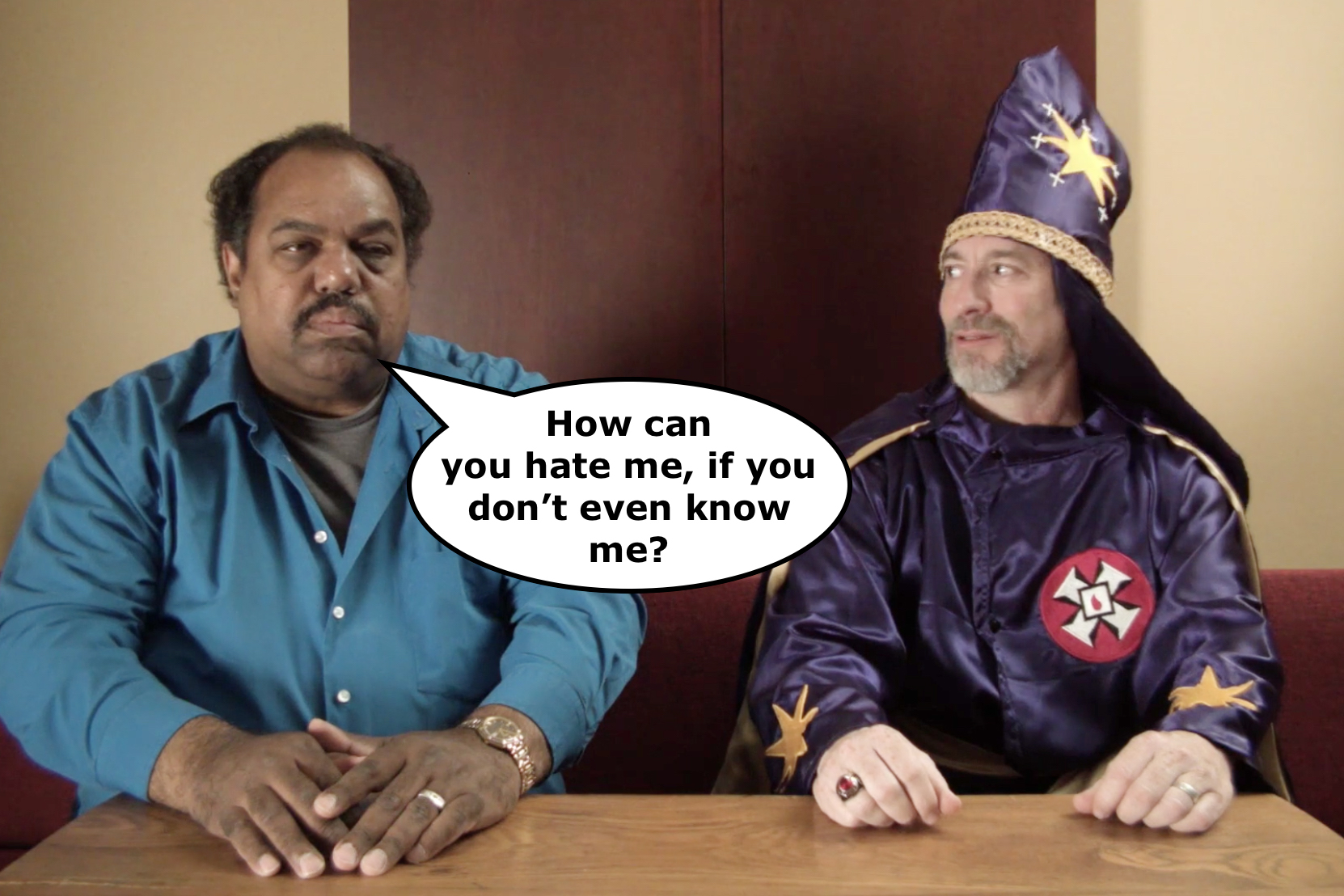
    In the last post I flagged a practical example of reducing inter-group communication to inter-personal relationships, and here it is. A few weeks ago I was down a Reddit rabbit hole and came across this AMA from Daryl Davis. In it he discusses his documentary ‘Accidental Courtesy that documents his relationship over the years with members of the Klu Klux Klan (KKK). After having a read through the pages of the AMA, I was intrigued and watched the documentary on Netflix.

    One poignant moment in the documentary is where he talks about his motivation for cultivating friendships with Klansmen. There the overriding question he asks is “How can you hate me if you don’t even know me?” From sitting down in a bar with Klansmen, to being invited into their home, this question—and the associated interpersonal interaction—drives the conversation at hand. The results show how successful it is, as Davis displays a wardrobe full of Klan robes that were given to him after members had left the Klan.

    Daryl Davis’ documentary is a strong example of the theory that we talked about in the last post. He is actively reducing inter-group interaction to inter-personal interaction by face-to-face contact and conversation.

    A couple of points from his AMA are worth repeating. He writes:

    While you are actively learning about someone else, realize that you are passively teaching them about yourself. Be honest and respectful to them, regardless of how offensive you may find them. You can let them know your disagreement but not in an offensive manner.

    Don’t be afraid to invite someone with a different opinion to your table. If everyone in your group agrees with one another and you shun those who don’t agree, how will anything ever change? You are doing nothing more than preaching to the choir.

    When two enemies are talking, they are not fighting, they are talking. They may be yelling and screaming and pounding their fist on the table in disagreement to drive home their point, but at least they are talking. It is when the talking ceases, that the ground becomes fertile for violence. So, KEEP THE CONVERSATION GOING.

    I highly recommend the documentary, which is available on Netflix: Accidental Courtesy. Its a good approach, and while it is focused on race relations in America, the concepts behind it are broadly applicable. If you don’t have Netflix, then NPR have an interview with Davis up here: http://www.npr.org/2017/08/20/544861933/how-one-man-convinced-200-ku-klux-klan-members-to-give-up-their-robes The AMA on Reddit also contains some absolute gold from Davis and others.

  • That Cooper’s ‘Keeping it Light’ Ad… what it got wrong and what is so very right.

    That Cooper’s ‘Keeping it Light’ Ad… what it got wrong and what is so very right.

    I’ve been meaning to write about this since March, when the original Coopers ‘Keeping it Light’ ad aired, but haven’t got around to it until now. However, I think that the take home points from that ad are just as relevant now—and perhaps even more relevant with the postal survey about to close.

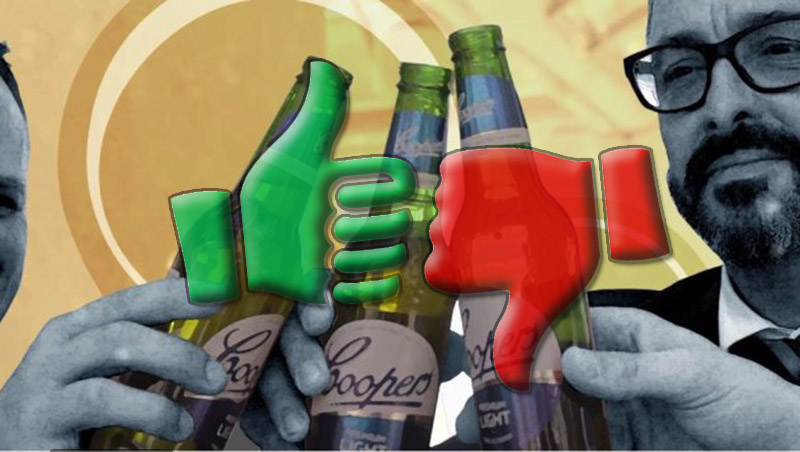
    For those who may have missed the furore—or more realistically are reading this from overseas, as it was pretty hard to miss here in Australia—it goes something like this. Coopers partners with the Bible Society Australia to produce a line of commemoratively tagged cans under the “Keeping it Light” slogan, and subsequently filmed an ad featuring two Liberal party MPs discussing Same Sex Marriage. Perhaps unsurprisingly this didn’t go down well with the general public, and after just a few days the entire campaign was pulled (campaign archive here). So, then, what are the take home points from this furore? Well, here are some things that the ad got very wrong, and one thing it actually got right.

    Getting it Wrong

    Perhaps the biggest thing that the ad got wrong was the overall tone of the discourse. By placing it within the context of a ‘light discussion’ the creative team behind the ad severely undercut the discourse that happened within the ‘debate’—the tone and content of which frankly was pretty mild. Primarily, this is because the topic of same sex marriage in Australia is considered—as in many other countries—a heavy topic, and one that evidently is serious enough to spend $122M on (don’t get me started on that). But to pitch it as a ‘light discussion’ was sorely misguided.

    Secondly though was the choice of conversation partners, in Liberal MPs Tim Wilson and Andrew Hastie. While the MPs do helpfully hold different positions, and Tim Wilson self-declares as same-sex attracted, they are notably both from the same party. That same party that has been notoriously resistant to allowing any discourse on the issue entirely. By pitching the debate as ‘light’ and between two members entrenched in a party that has traditionally disallowed this discussion both of the conversation partners are immediately categorised as part of a group that is negatively associated with same-sex marriage—despite Wilson’s own stated views.

    These two factors probably explain much of why the ad received so much negative attention and subsequent backlash. Leaving off the whole concept of light beer in the first place, which is a serious mispitch anyway.

    What it got Right

    However, not all is lost. Despite the massive failings of the ad, it did get one thing right: face-to-face discussions. Much of modern social discourse is conducted over relatively impersonal mediums such as social media. This goes for the SSM postal survey as much as it does for political debate (see Trump), and debates over race and gender. While these mediums give some semblance of interpersonal interaction, they lack much of the emotional engagement that interpersonal contact generates, as we have discussed here.

    What the Coopers ad gets right is that face-to-face one-on-one interaction defuses much of the group identity that is present on social media, and promotes interpersonal interaction instead. It, as social-identity theorists put it, reduces the salience of inter-group interaction, and increases the salience of inter-personal interaction. [ref]Haslam, S. Alexander. Psychology in Organizations. SAGE, 2004.,23[/ref] Why is this important? Well much of the literature on change of attitude in conflicting social groups emphasises that most of the change happens at an individual level, rather than at a social group level. Indeed, interaction at a group level ‘increases the perceived homogeneity of outgroups and consensus among the ingroup.’ Effectively entrenching views within those social groups.

    Perhaps then the take home from the Coopers ad is that if you really want to change someones mind on a contentious social-group issue, sit down with them face-to-face as individuals. Easy? No. But worthwhile. Just don’t use light beer. The next post in this series will focus on a practical example of this.

  • Complex Thinking – a skill sorely needed

    Complex Thinking – a skill sorely needed

    Came across this post today on applying Complex Thinking to current events. These six tenets that Michèle espouses are a great framework for engaging with the bevy of complex debates in our modern society.
    Patience, Effort, Courage, Retrospection, Tension and Thoughtfulness are all required across our debates in the public square–and especially in the private sphere. No matter your position on religion, politics, or even sport; all are required in greater measure.
    As she writes:

    I believe in Complex Thinking. And it is the antithesis of knee-jerk reacting. It requires the kind of emotional and intellectual self-control that feels insensitive under such heartrending circumstances.

    I highly recommend her post, go read it here: http://michelephoenix.com/2017/09/wheaton-college-complex-thinking/

  • Does Social Media help our Debate? – The Medium is the Message

    Does Social Media help our Debate? – The Medium is the Message

    This is the second of four (possibly more) posts in which I consider how our shift to social media as the forum of the polis affects our arguments.

    As we get deeper and deeper into this social media age, the question I often return to is whether or not social media helps or hinders our debate in this new digital ‘public square.’

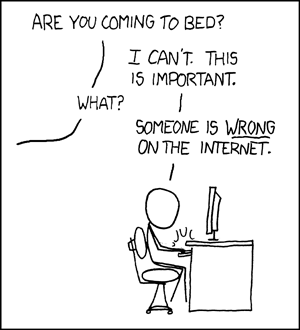
    A while ago a colleague was doing some research using eye tracking while participants looked at websites, and as an aside noted that many participants actively looked at other links on the screen, rather than the primary content of the website.[ref]Research was published as Benjamin Stone, ‘Using LSA Semantic Fields to Predict Eye Movement on Web Pages’, International Journal of Human-computer Studies 69/11 (2011): 720–740.[/ref] This seemed to indicate that people were more interested in finding another page and source of information than processing the information in front of them.

    https://xkcd.com/386/

    This serves as a helpful reminder of Marshall McLuhan’s thesis that it isn’t merely the message that determines attention and retention, but the medium of the message holds salience even within CMC.  In this case the very nature of reading articles and even books on a digital device reduces attention span within the overall populace. We should not be surprised when users interact with only a mere snippet of material, while ignoring the rest of the argument.

    In combination with the sheer volume of information available, this has significant detrimental effects. In sorting and filtering through the ever expanding sea of information, our heuristics to detect the ever dwindling signal to noise ratio have to become far coarser. In doing so our modern culture has condensed the information gathering process into a series of bite sized snippets. News articles have been condensed from the long-form essay, to short columns, and then pithy snippets, shared on Facebook, condensed into 140 character tweets, and subsequently regurgitated as 2-3 second sound bites. This reduction in information length has seen a corresponding reduction in the average attention span for all media; and the reduction doesn’t appear to be merely an expression of ‘the Elvis Hypothesis.'[ref]The Elvis bias is essentially an inverted appeal to novelty fallacy, or a modified appeal to tradition. Karina J. Linnell et al., ‘Urbanization decreases attentional engagement.’, Journal of Experimental Psychology: Human Perception and Performance 39/5 (2013): 1232–1247.[/ref]

    Ultimately, I think that engaging in public debate on social media may be a low return proposition, as a minimal amount of argument is engaged with, and much is skipped over rapidly, and this isn’t even considering the ‘echo chamber’ like filtering that many social media companies engage in.[ref]https://www.wired.com/2016/11/filter-bubble-destroying-democracy/[/ref]

    So, is there any point in public debate on social media? Is my writing and publishing of this piece (on social media) a futile exercise? Not quite, as we will see in future posts. But the situation is likely to get worse before it gets better.

  • Why I am becoming convinced that bifurcated argument on Social Media is detrimental

    Why I am becoming convinced that bifurcated argument on Social Media is detrimental

    During this current ‘not-plebicite’ season I have been asked several times on various social media platforms as to what my position on various aspects of the debate are. But, apart from one more sleep deprived enquiry about jurisprudence, I have decided that I won’t be posting on the topic. More than this, I am becoming convinced for a few reasons that the place for extended debate is not on social media.

    Much of this has come from revisiting some research I was involved in back when Tom was the ‘first friend’ you had, and Facebook was in its infancy (ok, it was 2006). Most of this research involved evaluating hugely expensive telepresence solutions such as the HP Halo system as means of improving computer mediated communication (CMC).

    Two aspects of this research I will briefly consider–and most of this post is drawn from a paper I wrote back in 2015, so some bits are dated, and it is written for academic presentation. On the upside there are footnotes 😉

    Emotional Confusion

    The first aspect is emotional confusion, which is often present within textual communication is often parodied in mainstream media. From the innocently worded text message being read in an unintended tone, to the innocuous social media message eliciting murderous responses. See that classic Key and Peele sketch on text message confusion here (language warning). The situations are so often parodied because they are highly relatable, many, if not all, of us have had similar experiences before. Why? Why does text on a screen elicit such powerful emotive responses, when the same message in other forms barely registers a tick on the Abraham-Hicks. Studies have shown that it is the sociality, or social presence of the medium that provides the best insight into the emotional regulation that can be so diversely represented in CMC.[ref]Antony S. R. Manstead, Martin Lea, and Jeannine Goh, ‘Facing the future: emotion communication and the presence of others in the age of video-mediated communication’, in Face-To-Face Communication over the Internet (Studies in Emotion and Social Interaction; Cambridge University Press, 2011), http://dx.doi.org/10.1017/CBO9780511977589.009.[/ref] Specifically in our case it is the factors of physical visibility, or more precisely, the lack thereof that impact on emotional regulation. When engaging in social interaction an enormous amount of social cues are communicated non-verbally, through facial features and mannerisms. Of course with CMC the majority of these are removed, and those that remain are relegated to the domain of various emoticons and emoji. Notably this devaluation of the majority of non-verbal social cues serves to reduce the salience of social presence, and therefore the corresponding salience of the interaction partner. It is this effect that has led several companies, including my previous employer, to invest millions into virtual telepresence systems in an attempt to mitigate the loss of visual cues and the salience of interpersonal interaction.

    What does that mean? Well in essence the vast majority of social cues for interpersonal interaction are removed on social media, and it is this context that assists in evaluating the emotional content of the message. From a social identity perspective Spears et al. found that within CMC based interactions both in-group and out-group salience and bounds were profoundly strengthened, and inter-group conflict was heightened.[ref]Russell Spears et al., ‘Computer-Mediated Communication as a Channel for Social Resistance The Strategic Side of SIDE’, Small Group Research 33/5 (2002): 555–574.[/ref] Furthermore, the degree of expression of these conflicts was also heightened along with the corresponding in-group solidarity expressions. Essentially, the majority of CMC interactions serve to strengthen positions, rather than act as bridges for meaningful communication. For more on that see my post a while ago on the Backfire Effect.

    Emotional Regulation

    The other side of this comes in terms of emotional regulation. On this Castella et al. studied the interactions found between CMC, video conferencing and face-to-face mediums and interestingly found that not only is there a heightened level of emotive behaviour for a non-visual CMC interaction.[ref]V. Orengo Castellá et al., ‘The influence of familiarity among group members, group atmosphere and assertiveness on uninhibited behavior through three different communication media’, Computers in Human Behavior 16/2 (2000): 141–159.[/ref] But also found that the emotive behaviour was significantly negatively biased. So it is not merely a heightening of all emotions, but as Derks et al also observed it ‘suggest[s] that positive emotions are expressed to the same extent as in F2F interactions, and that more intense negative emotions are even expressed more overtly in CMC.'[ref]Daantje Derks, Agneta H. Fischer, and Arjan E. R. Bos, ‘The role of emotion in computer-mediated communication: A review’, Computers in Human Behavior 24/3 (2008): 766–785.[/ref]

    Ultimately when people are emotionally confused, in low physical presence environments, they tend to react emotionally–and predominantly negatively. Hence, the majority of emotional expressions that will be found in CMC will be negative reactions from the extremes of any dialectical spectrum.

    What is the outcome of all of this then? Well simply put the very mechanism of computer mediated social media interacts with our own natural cognitive biases and produces an outcome that is predisposed towards burning bridges rather than building them. And this even before any considerations of social media echo chambers have been made (thats another post for another time).

    Where to?

    Sure, there will be always a plethora of anecdotal counters, but given human predisposition I think there is a better way. For me that better way is in person, in a setting where we can explore any conversation at length. So, if you want my views on the majority of controversial topics out there, come and talk to me over a coffee or beer.

  • Learning from Comics: Compilation of Oral Tradition and Making sense of Time and Narrative

    Learning from Comics: Compilation of Oral Tradition and Making sense of Time and Narrative

    I have been doing some musing recently on how compilations of oral traditions communicate time in linking a story together. For example if a series of stories about a person are communicated, does it necessarily matter the order that they are communicated in, and does the significance of that order change between different cultures?

    Say we have a collection of stories about Winnie the Pooh, labeled Scene A, B, C and D. Temporally they occurred in a certain order A > B > C > D, but what would happen if A.A. Milne decided to compile these as C, A, D, B? While in our Western concept of time and space this would appear unnatural and confusing, I’m not sure that this is universally applicable.

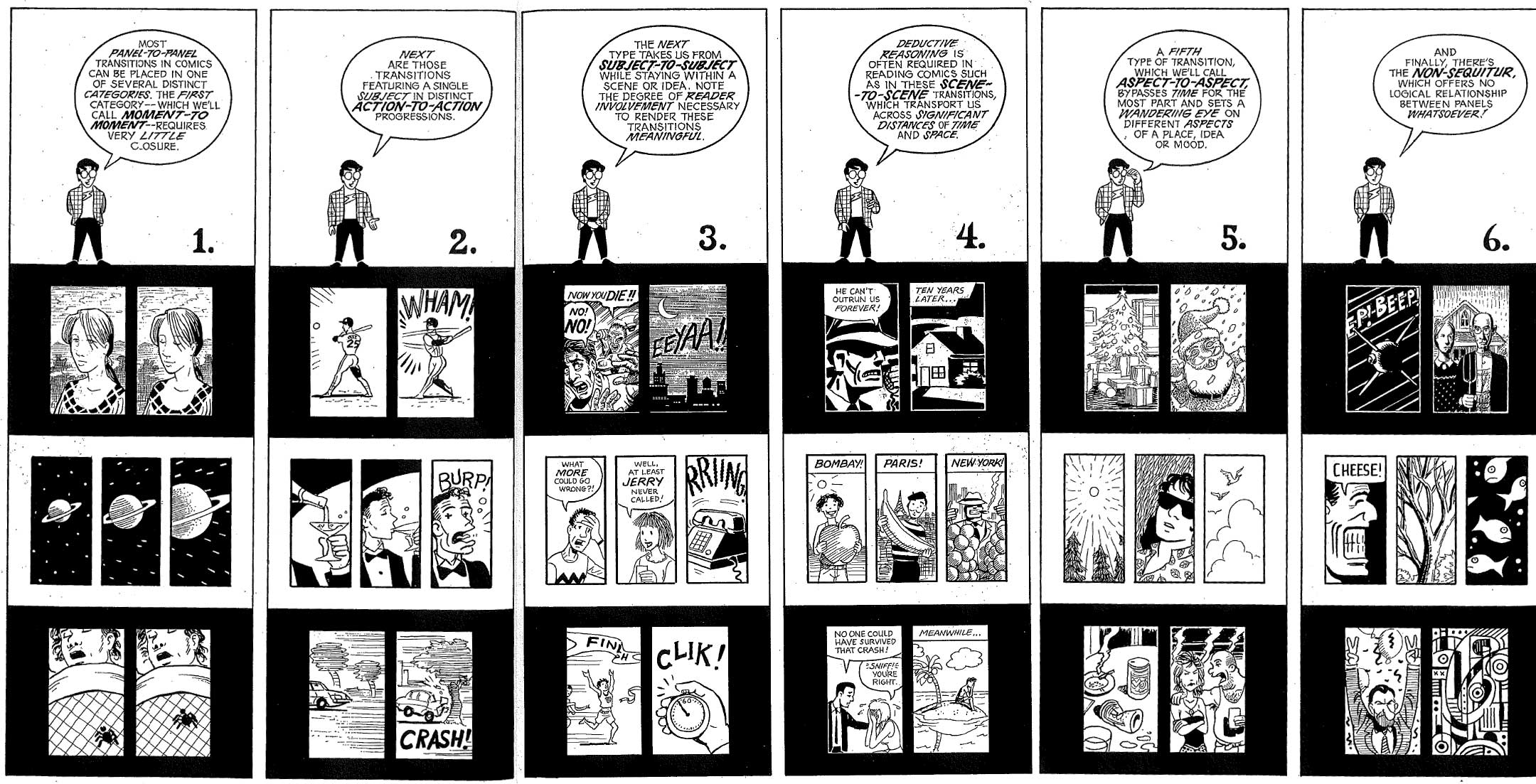
    In musing about this I went back to an old book I have around on how sequential artists communicate in their specific medium: comics. Scott McCloud provides a helpful series of categories that comic artists use in communicating transitions between their panels.

    Scott McCloud on Comic Transitions
    Scott McCloud on Comic Transitions (click for bigger)

    In the book (and elsewhere) he notes that the majority of Western comics reflect a western concept of time, and therefore use action-to-action or scene-to-scene transitions, that are specifically temporally linked. Interestingly Eastern (Japanese/Chinese) cultures tend to also use more subject-to-subject and aspect-to-aspect transitions in communication–as shown here in reflections on Ghost in the Shell: https://www.youtube.com/watch?v=gXTnl1FVFBw

    However, I think that the style of communication with subject-to-subject and aspect-to-aspect transitions is lost on a lot of Western audiences, as they impose a temporally sequential hermeneutic on the panels.

    What I have been wondering about is how this would apply to collections of oral traditions or memories. In many cases when Western trained scholars look at collections of oral tradition, such as the Gospel of John, or the book of Judges, it is presumed that the material must be temporally sequential in some form. But I have a sneaking suspicion that this is a particularly Greco-Roman concept, and that quite possibly the Hebrew/Jewish concept of time is more along the subject-to-subject and aspect-to-aspect line.

    This, I think, would significantly change how we interpret and centre the compilations of collections of oral traditions. The next question though is how does it change?

  • Tapping into my inner Luddite – Why I am returning to pen and paper for planning.

    Tapping into my inner Luddite – Why I am returning to pen and paper for planning.

    If you have been following this blog then you will know that I am no technological luddite, with many of the most viewed posts dealing with Zotero, Scrivener and other computer based writing management software.

    However, recently things have been changing, although perhaps not for the reasons that first come to mind. Perhaps a bit of background is appropriate though. Like many others my age, I grew up with the burgeoning computer period, but before they become so ubiquitous that we walk around with more processing power than Apollo in our pockets. Being in this liminal space means a few things. Firstly, it means that while I have had a long string of computerised assistive devices, I originally learnt to do most things without them. Secondly, I remember how annoying some physical processes were before the rise of easy digitisation, gone are reams of paper, and in comes the iPad. Finally, I also spent a lot of time at a computer without any particularly good OH&S advice.

    It is this last aspect that has been one for me of the driving forces towards digitisation over paper technologies. I have RSI and carpal tunnel in one hand, and as a result don’t write a huge amount, and therefore have exceedingly bad handwriting. Amusingly though it is also this aspect that recently I have found myself benefiting from. Simply put, when i want to scribble something down it takes effort, and that effort means that I think things through a bit more thoroughly. So when I am putting things in my diary, or making plans for different things, the extra effort actually helps in making good decisions or proper planning. I have written in the past about how this relates to students using higher cognitive load methods for note taking (see here for that post), but this is taking the same mechanism in a new direction.

    Therefore, this year–for the first time in about 10 years–I have bought myself a paper diary. While it is a pretty spiffy paper diary, and with all sorts of other advantages, it has really been helping me to pare back what I want to record and what I am planning to do. Now I still use my digital calendar for meeting reminders, and other things like that, but as a planner this mechanism seems to be far more effective for me at the moment.

    The planner I have decided to use is the Ink+Volt Planner (I backed it on Kickstarter) that has a few spiffy features, but one of the best is that each day is just split into three sections of time. This minimisation of the number of things you can cram into a period of time really helps with planning and execution of the things to do in a day. Note: this feature can also be implemented in other planners with a ruler and sharpie to limit the amount of space you have to write in, so give it a go and see what you think.

    Im interested if anyone else is experiencing the digital fatigue, and returning to pen and paper as well. Please comment below. Ill blog in the future about what using a pen and pad has done for my conference notes.

    Or perhaps I am just becoming a luddite hipster… after all I have rediscovered my vinyl collection too.